



















The Big Apple was once a capital of cigar rolling
Between 1880 and 1920, it is said that one out of every three American cigar was made in New York. And at that time, New-York City produced 10 times the number of cigars as Havana, Cuba!
New-York was the nation center of cigar manufacturing for two main reasons:
- The city was the hub of tobacco trade, both imported and domestic.
- The city was welcomed many immigrants who brought their cigar making skills with them!
Before and early in that period, cigars were made by hand only, and manufacturers rented apartments to turn into factories.
But that quickly changed with the advent of cigar mechanization in 1883. To make more money, the whole family could work under the direction of the family’s skilled roller, simply at home.
The wife, children and the rest of the family could work under the family roller, who was usually responsible of the wrapper stage, and general supervision.
This saved the manufacturers money and made the employees get more.
Over 1800 « apartment factories »
The skilled rollers took a sense of pride in their work, and it was rare that they go to work poorly dressed. Many families even hired readers in the factory, following Cuban tradition brought back by the immigrant workers. In midtown and lower Manhattan alone, there could be over 1800 cigar “apartment factories”! .

Cigar makers in New-York, 1890. Captured by Jacob Riis.
Mechanization enters the dance
To democratize and justify the automation of cigars, as opposed to the traditional hand-rolled cigar, manufacturers had to get creative.
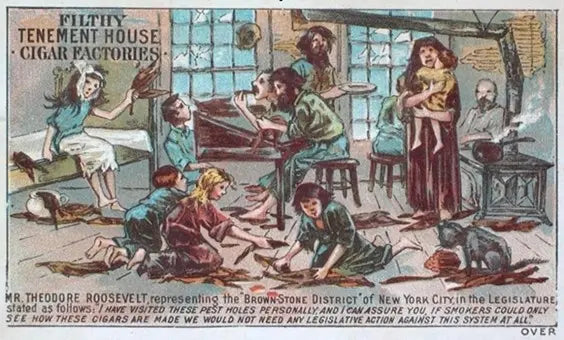
To justify this transition, without explaining the substantial savings they were making, manufacturers launched the "spit campaign."
Saying that hand-rolled cigars used saliva to stick the end of the cigar, while the machines kept the cigars more hygienic...
With the onset of the Great Depression (1929), cigar makers found it increasingly difficult to make a living and turned to other types of work.
Over the next decade, the industry weakened as mechanization and cheap foreign imports took over.
Small stores began to close, and it was the end of New-Yorkers rolling cigars at home.